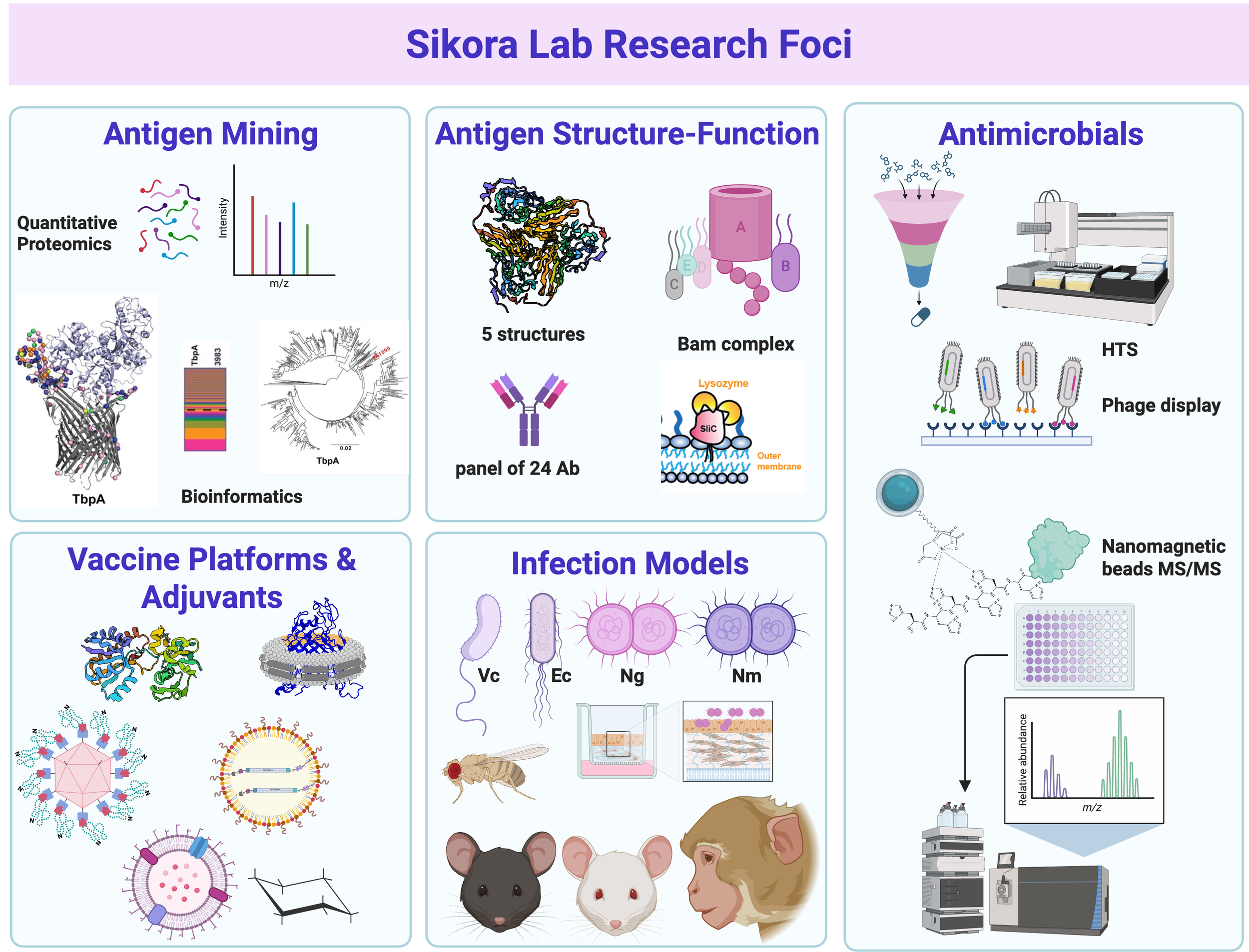
The Sikora Lab at Oregon State University develops vaccines and antimicrobials against Neisseria gonorrhoeae and other clinically relevant pathogenic bacteria. Using proteomics-driven antigen discovery, bioinformatics, immunoinformatics, and structure-function approaches, we identify and characterize protective antigens and small-molecule targets.
Our vaccine program tests candidates across multiple platforms, and our antimicrobial program combines high-throughput screening and phage display to discover new inhibitors of essential bacterial pathways.
Vaccine candidates and antimicrobials are evaluated in advanced preclinical models spanning 3D human tissue systems and animal infection models.
Research
-
We use proteomics-driven reverse vaccinology to identify surface-exposed and secreted proteins as vaccine candidates, prioritizing antigens that are conserved, accessible to the immune system, and essential for bacterial fitness or virulence. Bioinformatics and immunoinformatics pipelines further refine candidate selection by predicting epitopes, assessing sequence conservation across clinical isolates, and evaluating potential for cross-protection. Structural and functional characterization of lead antigens informs immunogen design and clarifies mechanisms of protective immunity.
-
We test lead antigens across multiple complementary delivery platforms, allowing us to compare immunogenicity, protective efficacy, and mucosal responses. Platforms include recombinant subunit proteins formulated with different adjuvants; outer membrane vesicles (OMVs) that present native antigens with intrinsic adjuvant activity; virus-like particles (VLPs) for modular antigen display; nucleic acid–based vaccines; and different vectors engineered for mucosal delivery via oral immunization.
-
We evaluate vaccine candidates in advanced preclinical models that bridge in vitro discovery and translational assessment. Three-dimensional human mucosal models allow us to study infection, immune responses, and vaccine-induced protection in a human-relevant tissue context. Complementary murine immunization and challenge studies use standard and specialized mouse strains to assess immunogenicity, protective efficacy, and mechanisms of protection.
-
Understanding what constitutes a protective immune response is central to translating vaccine candidates toward clinical development. We integrate quantitative and functional immunoassays with rigorous biostatistical analysis to identify antibody and cellular parameters that correlate with protection. Complementary mechanistic studies build a full picture of protective immunity and inform vaccine design.
-
In parallel with vaccine development, we discover and characterize novel antimicrobials targeting essential bacterial pathways in Neisseria gonorrhoeae and other drug-resistant bacteria. Our approach combines high-throughput screening, phage display, and target-based discovery, followed by mechanism-of-action studies and evaluation in infection models. This program has produced patented inhibitors of key gonococcal enzymes and continues to identify new leads with therapeutic potential.